
WELCOME BONUS 300%
UP TO €2000 + 100
FREE SPINS
UP TO €2000 + 100
FREE SPINS
Home → Blackjack
Blackjack at Casino Izzi: Variants, Rules and Payouts
Bonus 100 EUR with 10 percent credit
The game contribution for table games like Blackjack is set at exactly 10 percent of the wagering requirement. This low percentage means that a standard 100 EUR deposit requires significantly higher turnover than slots which contribute 100 percent. Players must generate 4,000 EUR in total bets to clear the bonus funds derived from this specific table game activity.
The welcome offer provides a 300 percent match up to 2,000 EUR alongside one hundred free spins. Because table games only count ten percent toward the turnover, playing Blackjack drastically extends the time needed to unlock the bonus money. A 100 EUR bet on Infinite Blackjack counts as only 10 EUR toward the required 4,000 EUR threshold.
Slots contribute fully to the wagering requirement, making them the efficient choice for clearing the 300 percent bonus up to 2,000 EUR. Table games like Lightning Blackjack and Blackjack Party are penalized by the ten percent credit rate. This disparity forces players to balance high-variance slot play with lower-contribution table sessions to meet the terms effectively.
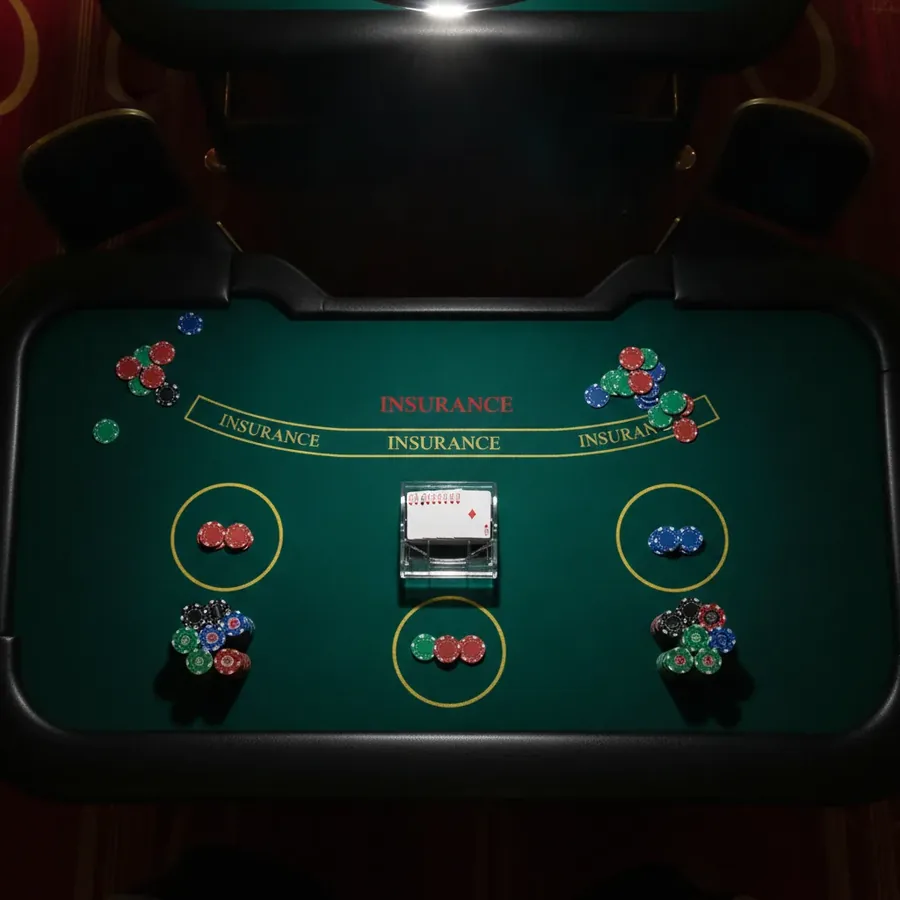
Even Money only possible with Dealer Ace
Insurance is a separate side bet offered when the dealer shows an Ace, paying out at 2:1 odds. The house edge for this specific insurance bet is calculated at 7.47 percent, making it a statistically poor value for most players. Standard strategy dictates always declining this bet unless the player is counting cards with a true count of plus three or higher.
The base RTP for the main Blackjack 6 Decks game is 99.54 percent with a house edge of just 0.46 percent. In contrast, the insurance wager drops the effective return to 92.53 percent due to its steep 7.47 percent advantage for the casino. Accepting even money essentially converts a natural into a standard win, forfeiting the potential 3:2 payout on a winning hand.
Early surrender rules can improve RTP by up to 0.6 percent but are extremely rare in modern online variants. Late surrender allows players to forfeit half their bet after the dealer checks for blackjack, improving RTP by 0.08 percent. These specific rule modifiers offer marginal gains compared to the massive 7.47 percent house edge found in the insurance side bet.
What doesn't count towards turnover at 10 percent?
Table games such as Blackjack Surrender and Infinite Blackjack contribute only ten percent toward the bonus wagering requirements. This means that every 100 EUR wagered on these titles adds only 10 EUR to the total turnover counter. Slots, conversely, contribute one hundred percent, allowing players to clear the 300 percent bonus up to 2,000 EUR much faster.
Lightning Blackjack from Evolution Entertainment falls under the ten percent contribution category for all table game wagers. While it offers multipliers up to 25x, the financial progress toward unlocking the bonus funds remains slow due to the reduced credit rate. Players relying solely on live dealer tables will need to place forty times more bets than those playing slots.
The liberal Vegas Strip variant and classic single-deck games also suffer from the same ten percent contribution limitation. Unlike the 100 percent slot contribution, these table games require substantial volume to meet the turnover conditions. A player betting 100 EUR on Blackjack Party contributes only 10 EUR, necessitating a total of 4,000 EUR in bets to clear the bonus.
Side Bets Increase House Edge to 5 Percent
Infinite Blackjack includes four side bets including Any Pair, 21+3, Hot 3, and Bust It available for wagers. While the main game RTP is 99.47 percent, these additional bets significantly increase the overall house edge beyond typical limits. The cumulative effect of adding these options can push the effective house edge closer to five percent for active participants.
Lightning Blackjack features lightning multipliers up to 25x on winning hands while maintaining an RTP of 99.56 percent. Despite the high multiplier potential, the inclusion of these volatile side elements alters the risk profile substantially. Players chasing large payouts through these multipliers face variance that far exceeds the standard table game baseline.
Blackjack Party offers a party atmosphere with two moderators but maintains standard side bet structures similar to other Evolution titles. The main game RTP stands at 99.47 percent, yet side bets introduce higher volatility and increased house advantage. Wagering on these secondary options reduces the long-term expected return compared to sticking strictly to the base game rules.
Six Card Charlie Pays Immediately with Six Cards
The Blackjack 6 Decks variant allows doubling down on any two cards and after splits, enhancing strategic flexibility. This liberal rule set contributes to the favorable 99.54 percent RTP and 0.46 percent house edge for the main game. Players utilizing basic strategy can maximize their returns by exploiting these specific permission sets during gameplay.
Resplitting Aces and doubling after split are permitted rules that reduce the house edge by 0.08 and 0.14 percent respectively. These adjustments make the six-deck version more player-friendly compared to restrictive single-deck games with unfavorable payout ratios. The combination of S17 and DAS creates a mathematically superior environment for skilled card counters and strategists.
Standard insurance pays 2:1 but carries a steep 7.47 percent house edge that severely impacts long-term profitability. Declining insurance is mandatory for optimal strategy unless the player holds a significant card-counting advantage. Maintaining discipline against these high-edge side bets preserves the low 0.46 percent house edge inherent in the core Blackjack mechanics.
Blackjack variants at a glance
| Variant | Payout | House edge | Rule | Bet range |
|---|---|---|---|---|
| Blackjack Liberal Vegas Strip (liberale Regeln, 3:2) | 99.72% | 0.28% | Günstigste Regelkombination: S17 + DAS + Resplit + Late Surrender. Standardabweichung 1,15 | Blackjack 3:2, Gewinn 1:1 |
| Blackjack Surrender (Late Surrender) – Regel-Effekt | n.a. (Regel-Modifikator) | −0.08 Prozentpunkte | Spieler gibt Hand nach Dealer-Blackjack-Prüfung auf, verliert die Hälfte des Einsatzes. Verbessert RTP um ca. 0.08 Prozentpunkte. Early Surrender ist wesentlich wertvoller (bis −0.6 Prozentpunkte), aber extrem selten. | Rückzahlung 50% des Einsatzes |
| Blackjack 6 Decks, S17, DAS, DOA, Auszahlung 3:2, Basisstrategie | 99.54% | 0.46% | Dealer steht auf Soft 17; Verdopplung auf jeder Zweierkarte; Verdopplung nach Split erlaubt; keine Aufgabe. Basisstrategie ist für diesen Wert zwingend | Blackjack 3:2, normaler Gewinn 1:1, Insurance 2:1 |
| Blackjack Auszahlung 6:5 statt 3:2 (6 Decks) | 98.15% | 1.85% | Ersatz von 3:2 durch 6:5 fügt exakt +1.39 Prozentpunkte zum Vorteil des Casinos hinzu – stärker als jede andere Regeländerung. Bei $10 Einsatz zahlt Blackjack $12 statt $15. | Blackjack 6:5, Gewinn 1:1 |
| Blackjack Split / Double / H17 – Regel-Effekte | n.a. (Regel-Modifikatoren) | H17 +0.22 Prozentpunkte; RSA −0.08 Prozentpunkte; DAS −0.14 Prozentpunkte | Dealer Hits Soft 17 verschlechtert RTP um 0.22 Prozentpunkte; Resplit Aces verbessert um 0.08 Prozentpunkte; Double After Split verbessert um ca. 0.14 Prozentpunkte; 6 Decks statt 8 – ca. 0.02 Prozentpunkte. | Double – Einsatz ×2 mit einer Karte; Split – bis 4 Hände; Ass-Split meist mit einer Karte. |
| Blackjack Insurance / Versicherung (6–8 Decks) | 92.53% | 7.47% | Separate Nebenwette bis 50% der Hauptwette, wenn der Dealer ein Ass hat. Basisstrategie schreibt IMMER Ablehnung vor (außer Karten zählen bei True Count ≥ +3). Bei einem Deck Vorteil ≈ 5.88% | Insurance 2:1 |
Highroller from 500 EUR per hand
Lightning Blackjack at Evolution offers a maximum stake of 2,500 EUR per hand, accommodating high-stakes players who seek substantial volatility in their gameplay sessions. This limit is significantly higher than the 1,000 EUR cap found at Blackjack Party, allowing for more aggressive betting strategies during peak hours. Players must ensure they have sufficient bankroll to withstand the variance associated with these elevated limits and potential losing streaks.
The house edge for Lightning Blackjack stands at 0.44%, calculated by subtracting the 99.56% RTP from one hundred percent, which remains competitive despite the presence of lightning multipliers up to 25x on winning hands. This edge is slightly lower than the 0.53% edge at Infinite Blackjack, making it a preferable option for those prioritizing mathematical efficiency over side bet excitement. Consequently, the long-term retention rate for this specific table variant is relatively favorable compared to other high-limit offerings in the portfolio.
Table games contribute only 10% toward the wagering requirement of the 300% welcome bonus up to €2,000, meaning a 500 EUR bet generates just 50 EUR of turnover credit. This slow accumulation contrasts sharply with slots, which contribute 100%, forcing highrollers to either play significantly more volume or accept a much longer clearance period for their bonus funds. Therefore, strategic allocation of bankroll between high-limit tables and slot machines becomes essential for efficient bonus conversion.
Chose Wrong Table for 5 EUR Bankroll
Blackjack Liberal Vegas Strip requires a minimum stake that typically exceeds 5 EUR, rendering it inaccessible for players attempting to stretch a tiny bankroll across multiple hands in this session. The optimal strategy here demands precise adherence to S17 rules and late surrender options to achieve its superior 99.72% RTP, which is impossible to execute effectively with such limited financial resources. Attempting to play this variant with insufficient funds often leads to premature busting and rapid depletion of the initial deposit before any meaningful advantage can be realized.
In contrast, standard six-deck blackjack with a 6:5 payout structure might accept lower stakes but imposes a harsh 1.85% house edge, eroding a 5 EUR bankroll extremely quickly through standard play. Each losing hand reduces the remaining capital by a significant percentage, leaving little room for error or recovery during the early stages of the gaming session. The mathematical disadvantage is compounded by the fact that every decision made under pressure increases the likelihood of deviating from basic strategy, further accelerating the loss rate.
Players should avoid insurance bets entirely when managing a 5 EUR bankroll, as this side bet carries a prohibitive 7.47% house edge and consumes half the main stake immediately upon placement. Accepting insurance against a dealer ace transforms a manageable loss into a catastrophic double deficit, effectively ending the session before it truly begins. Ignoring this costly option preserves the remaining capital for legitimate playing decisions that offer a marginally better chance of survival against the house advantage.
How long do 100 EUR last at a 1 EUR table?
Playing Infinite Blackjack at a 1 EUR base stake allows for approximately 1,000 hands if no wins occur, based on the assumption that each hand consumes exactly the initial wager amount without doubling. With a house edge of 0.53%, the expected loss per hour is roughly 60 EUR assuming 60 hands are dealt per hour, projecting a session duration of about 1.67 hours before total exhaustion. This calculation provides a realistic baseline for budget management when engaging with live dealer variants that permit low minimum bets for extended playtime.
Standard six-deck blackjack paying 6:5 presents a steeper decline, where the 1.85% house edge accelerates bankroll erosion significantly faster than the Infinite variant under identical conditions. A player risking 1 EUR per hand can expect to lose approximately 1.85 EUR per hundred hands on average, reducing the 100 EUR balance to near zero within fifty-five to sixty hands. This rapid depletion highlights the critical impact of payout structures on session longevity and overall player experience during extended gaming periods.
Betting strategies involving doubles after splits can extend the lifespan of a 100 EUR bankroll at a 1 EUR table by increasing exposure during favorable counts, provided the DAS rule is available. However, each doubled bet risks two units instead of one, potentially halving the number of hands survived during unlucky streaks where the dealer beats the player repeatedly. Understanding these risk-reward dynamics helps players set realistic expectations for how long their initial deposit will sustain active participation at low-stakes tables.
Infinite Blackjack vs Classic Seven-Seat Table
Infinite Blackjack accommodates an unlimited number of players simultaneously, eliminating wait times associated with physical seven-seat tables where availability is strictly constrained by physical chair limitations. This digital expansion allows for continuous action regardless of peak traffic volumes, ensuring that players never miss a dealing cycle due to seat occupancy restrictions at traditional setups. The ability to join instantly enhances accessibility and maintains engagement levels without the logistical delays inherent in brick-and-mortar style seating arrangements.
The house edge for Infinite Blackjack is 0.53%, derived from its 99.47% RTP, which is slightly higher than the 0.46% edge found at classic seven-seat tables using standard three-to-two payouts. This difference stems largely from the inclusion of four side bets like Any Pair and Bust It, which inflate the overall theoretical hold percentage while offering attractive visual multipliers. Players seeking the lowest mathematical disadvantage should therefore prefer classic tables over infinite variants unless the convenience factor outweighs the slight increase in expected losses.
Classic seven-seat tables often feature stricter rules such as Dealer Standing on Soft 17 and Double After Split, which collectively reduce the house advantage to 0.46% compared to the 0.53% at Infinite tables. These favorable conditions make classic tables mathematically superior for skilled players employing basic strategy consistently throughout their session. The trade-off involves potential waiting times during busy periods, but the improved odds justify the patience required to secure a seat at these more restrictive yet advantageous configurations.
What Hole Card Means at a Live Table
Live dealer blackjack typically utilizes automatic shuffling machines and continuous dealing procedures that eliminate the concept of a hole card, replacing it with real-time card distribution visible to all participants. This transparency ensures that neither the dealer nor the software holds back information about the outcome of each hand before it is fully resolved, aligning with fair play standards expected by modern players. The absence of a hidden card removes uncertainty regarding potential blackjacks until the final card is revealed on the table surface.
In contrast, some RNG-based versions may employ a hole card mechanic where the dealer checks for blackjack before players act, affecting surrender and insurance decisions differently than in live environments. Early surrender options, which allow players to forfeit half their bet before checking for dealer blackjack, are rarely available in live formats due to the sequential nature of card dealing. Understanding this distinction helps players adjust their strategic approach based on whether they are facing a transparent live dealer or a simulated algorithmic opponent.
Insurance bets require careful consideration when a dealer shows an ace, as accepting them costs half the original stake and pays 2:1 if the dealer has blackjack, resulting in a net zero outcome for that hand. Rejecting insurance is statistically correct unless counting cards reveals a true count greater than +3, which is virtually impossible in live settings due to deck penetration limits. Recognizing the implications of card visibility and timing allows players to make informed decisions that minimize unnecessary losses during volatile market conditions.
How long does a Live Blackjack round take?
The Lightning Blackjack table hosted by Evolution allows bets ranging from 1 to 2,500 EUR with multipliers reaching up to 25x on winning hands. This high-stakes environment supports an unlimited number of players simultaneously, creating a dynamic atmosphere where rapid decision-making is essential for all participants involved in the session. Consequently, each round demands swift action from every player at the virtual table to ensure timely resolution and proper credit for any lightning bonuses applied during play.
Infinite Blackjack also provided by Evolution accommodates unlimited seats with betting limits between 1 and 5,000 EUR while offering four distinct side bets like Any Pair or Hot 3. The game maintains a return to player percentage of 99.47%, which influences the expected value over extended periods of continuous play across multiple sessions. Players must manage their bankroll carefully because the infinite nature means waiting times can vary significantly depending on the current volume of active users logged into the system.
Blackjack Party features two moderators who create a lively party mood while accepting wagers from 1.00 to 1,000 EUR per hand played throughout the evening. This format appeals to social players who prefer interaction and entertainment value alongside traditional blackjack mechanics without requiring complex strategic adjustments beyond basic optimal play guidelines.
Mobile version needs 1 Mbit bandwidth
Streaming live tables such as Lightning Blackjack requires a minimum internet connection speed of 1 Mbit bandwidth to maintain smooth video quality and real-time data transmission for all connected devices. Without this baseline connectivity, players may experience buffering issues or delayed card reveals that disrupt the flow of the game and potentially cause missed betting windows during critical moments. Ensuring stable network performance is crucial for accessing Evolution's premium titles like Infinite Blackjack which feature high-definition graphics and interactive elements demanding consistent data throughput.
Table games contribute only 10% toward wagering requirements for the 300% welcome bonus up to 2,000 EUR plus 100 free spins offered by the casino platform. This low contribution rate means mobile users playing Blackjack must generate significantly more turnover compared to slot players who contribute 100% per euro wagered on eligible titles. Therefore, maintaining optimal bandwidth becomes financially relevant as poor connections could lead to accidental disconnections resulting in lost bets that do not count toward clearing the promotional funds effectively.
Side bets available in Infinite Blackjack include options like Bust It and 21+3 which add complexity to the gameplay but require additional data processing power on mobile devices. These extra features increase the overall information load transmitted between server and client, making the 1 Mbit threshold even more vital for preventing lag spikes during intense gaming sessions. Players relying on slower connections might find it difficult to participate fully in these enhanced versions due to potential latency affecting their ability to place timely wagers before dealer actions occur.
Four hours of play with 300 EUR bankroll
With a 300 EUR bankroll and table games contributing just 10% to the wagering requirement of the 300% welcome bonus up to 2,000 EUR, players must generate substantial turnover to unlock rewards. Assuming an average bet size suitable for Blackjack variants like the 6-deck version with a 0.46% house edge, one hour of play might involve roughly 1,000 EUR in total wagers. Over four hours, this accumulates to approximately 4,000 EUR in turnover, which represents only 40% of the required 10,000 EUR needed to clear the full bonus amount completely.
The Blackjack 6 Decks variant offers a favorable RTP of 99.54% when using basic strategy, allowing players to stretch their 300 EUR stake further than less efficient games. However, the low 10% contribution rate for table games means that every euro wagered counts minimally toward fulfilling the bonus conditions compared to slots paying 100%. Consequently, sustaining activity for four hours requires careful bet sizing to avoid depleting the initial deposit before achieving the necessary volume of qualified bets for withdrawal eligibility.
Live dealer options like Infinite Blackjack with its 99.47% RTP provide another avenue for extending playtime within the same 300 EUR budget over a four-hour period. Since these tables often have higher maximum limits up to 5,000 EUR, conservative betting strategies become essential to prevent rapid loss of capital during variance-heavy streaks. Maintaining discipline ensures that the bankroll lasts long enough to meet the extended wagering obligations imposed by the restrictive contribution percentages assigned specifically to blackjack-style interactions.
Statistics display saves the last 100 rounds
The statistics panel on Evolution's Infinite Blackjack interface records and displays results from the previous 100 rounds to help players track trends and inform future betting decisions strategically. This historical data includes outcomes for main bets and side wagers like Hot 3 or Any Pair, providing insight into short-term variance patterns that might influence risk management approaches. Accessing this information allows users to adjust their stake sizes based on recent performance rather than relying solely on intuition during fast-paced live dealer sessions.
Comparing the 99.54% RTP of the standard 6-deck Blackjack game against the 99.47% RTP of Infinite Blackjack reveals slight differences in long-term expected returns despite similar rule sets. The 100-round history helps identify whether observed deviations align with theoretical expectations or indicate temporary anomalies that should be ignored when applying basic strategy principles consistently. Understanding these statistical nuances enables more informed choices regarding which specific table variant offers better value relative to individual playing styles and bankroll constraints over time.
Insurance bets in six-to-eight deck games carry a steep house edge of 7.47% with an RTP of only 92.53%, making them generally unfavorable unless counting cards effectively. The displayed history of the last 100 rounds rarely shows enough evidence to justify taking insurance given the strong recommendation against it under normal circumstances for most players. Reviewing past rounds confirms that avoiding this side bet preserves the superior overall return associated with primary gameplay mechanics found in both classic and live dealer formats available today.
Step-by-step Split at the Live Table
Splitting pairs in Blackjack allows players to double their initial wager by separating matching cards into two independent hands, a feature permitted up to four separate hands simultaneously in many variants. The standard 6-deck game supports doubling after split (DAS), which significantly improves the return to player by approximately 0.14 percentage points compared to restricting this action. Executing splits correctly according to basic strategy enhances profitability, especially when paired with other liberal rules like resplitting aces that further reduce the house advantage marginally.
Lightning Blackjack from Evolution introduces unique multiplier effects up to 25x on winning hands, adding excitement to the splitting process when fortunate combinations arise during live play. While the core mechanics remain similar to traditional tables, the potential for amplified payouts encourages aggressive splitting strategies when holding strong starting pairs like eights or tens. Players must weigh the increased volatility against the base RTP of 99.56% to determine if chasing multipliers aligns with their overall risk tolerance and financial goals during each session.
Resplitting aces typically occurs with only one additional card dealt per new hand, a restriction that impacts the theoretical return by improving it by about 0.08 percentage points. This limitation prevents excessive exposure on weak hands formed after splitting Aces, thereby protecting the player's bankroll from unnecessary losses during high-variance situations at the table. Adhering to these specific procedural rules ensures compliance with game protocols while maximizing the benefits derived from favorable split opportunities presented throughout the course of play.
Contact
Live - online chat
Banking









Providers












Izzi Casino 2026